There comes a time in life when the noise fades, the students thin, and the path becomes more personal. For many martial artists over 60—especially those continuing after injury, surgery, or simply the passage of time—training karate alone at home is no longer a compromise.
It is a return to essence.
Far from being a lesser form of practice, solo training offers something uniquely powerful: the opportunity to refine, rebuild, and deepen one’s karate at the most fundamental level.
Technique Without Distraction
In a traditional class setting, attention is divided—between instruction, pacing, and the energy of others. At home, the mirror becomes your instructor, and time becomes your ally.
Each movement can be slowed down.
Each stance can be examined carefully.
Each technique can be felt, rather than performed.
At 60, this shift is critical. The focus moves away from speed and force, and toward precision and efficiency. You begin to ask:
Is my weight truly centered? Is my hip driving the technique, or is it just my arms? Is there tension where there should be relaxation? Am I moving from my center?
This level of detail is where true self mastery lives.
Kata as Living Practice
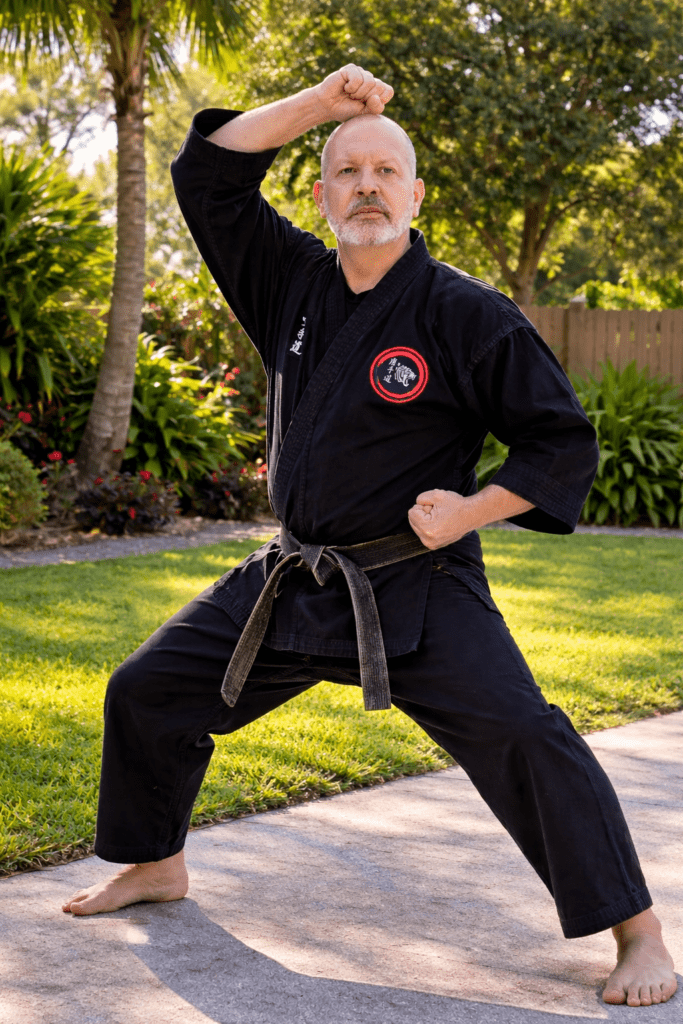
Hyung or Kata, when practiced alone, transforms.
No longer a performance, it becomes a conversation—between body, breath, and intention. Without the pressure of demonstration, you can explore kata at different speeds, with different levels of tension, and with a deeper awareness of application.
At this stage of life, kata becomes less about memorization and more about embodiment, paying attention to the smallest details.
You are not “doing” the kata.
You are becoming it.
Slow kata builds strength and control.
Explosive kata maintains spirit and vitality.
Focused kata sharpens the mind.
This is where decades of training begin to reveal their meaning as you adapt, evolve, and make each kata your own.
Rebuilding Balance and Stability
After 60—and especially after physical setbacks like knee replacements—balance is no longer something to take for granted. It must be trained deliberately.
Solo practice creates the ideal environment for this.
Holding stances longer.
Moving with intention between positions.
Executing kicks with control rather than height.
These small adjustments build stability not just for karate, but for life itself. Every step becomes more grounded. Every movement more secure.
Karate, in this sense, becomes functional longevity training.
The Mind Becomes the Dojang
Training alone strips away external motivation. There is no instructor or students watching. No classmates pushing you. No schedule forcing you to show up.
What remains is discipline.
You must choose to step onto the floor.
You must choose to bow in.
You must choose to continue each and every day.
This is where the real training begins.
Over time, this quiet consistency builds something deeper than physical ability—it builds character. The mind becomes sharper, calmer, and more resilient.
You begin to train not because you have to, but because it is who you are, and it has become a part of your spirit and being.
Forging the Mature Warrior Spirit
The warrior spirit at 20 is often fueled by competition, strength, and ego.
At 60, it is something entirely different.
It is persistence in the face of limitation, humility in the face of time, and courage in continuing the path when others have stopped.
Training alone at home becomes a forge for the mature spirit. There are no shortcuts, no applause—only the quiet satisfaction of showing up and doing the work.
This is not the spirit of conquest.
It is the spirit of endurance.
A Return to the True Path
In many ways, training alone brings karate back to its roots. Before large classes and modern dojangs, there was simply the individual—practicing, refining, and seeking self-perfection.
Instructors didn’t answer tons of questions, you watched your instructor demonstrate and you copied what he did again and again until you got it right.
At 60, this return is not a step backward.
It is a step deeper.
The kicks may be lower.
The movements may be slower.
But the understanding is far greater.
The warrior spirit gets stronger and more peaceful.
And perhaps that is the true goal all along—not to perform karate, but to live it.