Tang Soo Do has been a huge part of my life for 40 years, and it has shaped who I am as a person today. But what do you have left when you are no longer able to perform the high, spinning, jumping kicks and techniques that the Korean martial arts are known for? Is it still Tang Soo Do?
When Your Biggest Opponent is Your Body
It has been over two years since my total knee replacements, and I still have limitations. I have wrestled with this as I try to regain my skills and re-master all I have learned.
My knees still have stiffness, I cannot pivot sharply, and they do not allow for a full squat, kneeling, or jumping. I am finding that the limitations are more than I thought they would be before the surgeries.
While they are definitely better than they were before, I expected better results. The adaptations I’ve had to make to my training have altered what I practiced for forty years.
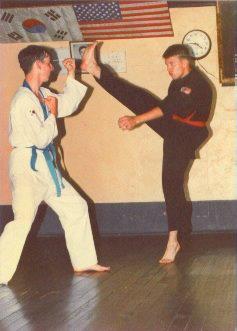
It doesn’t look the same, approach training or self-defense in the same way, and the focus has changed……but it is still Tang Soo Do, Way of the China Hand. You see, Tang Soo Do is the Korean pronunciation of the original way Kara-Te was written before Gichin Funakoshi changed the characters to mean “Empty Hand”.
Tang Soo Do is Karate, and Karate is what I still study and practice.
The Changes
My training is beginning to look different from what it used to be and how I was taught. My balance is still a bit off, even though I have raised the stances to take stress off my knees. I am also shortening my steps, focusing more on moving from my center and keeping my center of gravity centered and stable.
Pivoting round kicks are out, as are any jumping or spinning kicks, and I am still working on lead leg round kicks, side kicks, and the front kick. I no longer strike targets or a heavy bag, nor do I lock out kicks with power, all things that can loosen or mess up my knees and the implants.
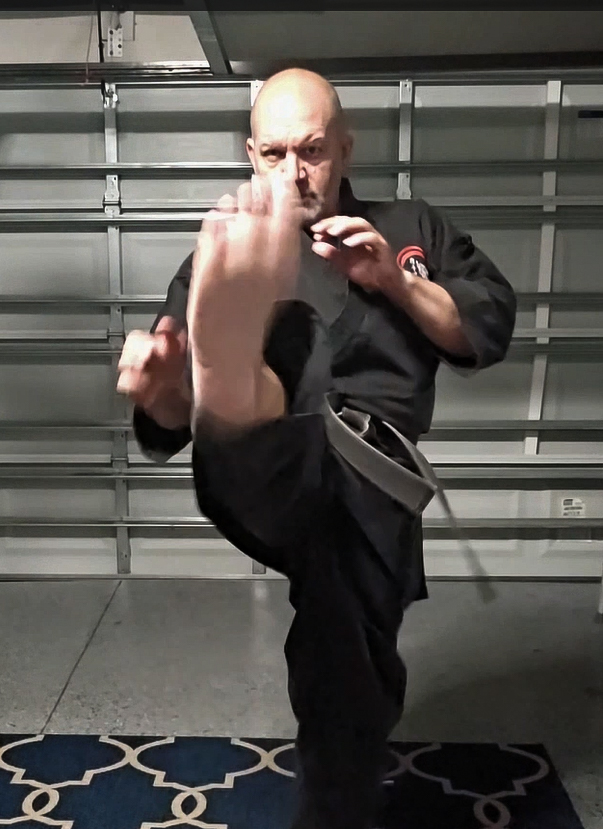
To make these adjustments, I look to Tang Soo Do’s roots in Okinawan Karate, not blindly changing things on a whim. My goal is to stay true to the art I learned and keep it as close to the original as possible as I age.
While my physical training is evolving, I continue to stay true to the Traditional Tang Soo Do as taught to me by my late instructor Master Yun Tak Bong, and above all, my faith in God and His Word.
My focus now is on form and relaxation rather than maximum power and strength. At times, I slow it down to the point it resembles Tai Chi instead of Karate, and that too serves a purpose. Moving slowly with intent and focus allows me to feel every little thing in my body and concentrate on balance and stability in my movements, where momentum would have carried me through before.
My training now is solely for me, my mental strength, and peace. A piece of South Korea came with me and has remained in my heart since the day I left, and that indomitable spirit refuses to let me quit.
It’s not your physical ability and prowess that determine if you are a martial artist or a black belt. It’s your heart, discipline, actions, and how you carry yourself in daily life.
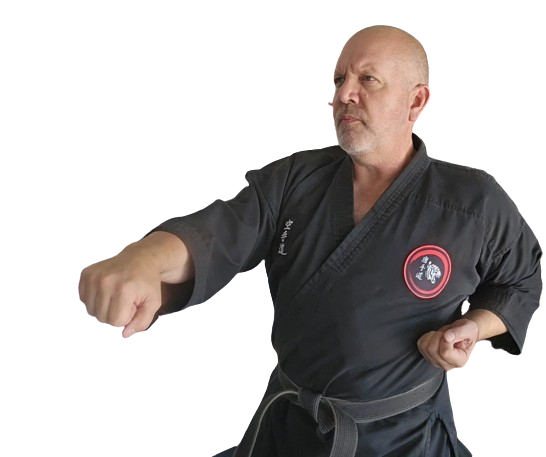
Everyone’s physical ability will wane and deteriorate at some point, but it’s not the end when that day comes. It’s the day you sit and reflect on why you started down this path in the first place, what your art means to you, and what you stand for. Then you need to honestly assess your limitations and adapt your training so you can continue your journey.
Quitting is not an option (at least it doesn’t need to be).
At some point, every martial artist needs to make their chosen path their own. For me, it has always been Traditional Korean Tang Soo Do “Way of the China Hand”. But life happens, and how I can train today is not Tang Soo Do, and that’s okay.
Despite my limitations, my journey and warrior spirit continue, and I go forward with a student mindset, continuing to learn, evolve, and find MY Karate.